Chiang's Re-Election Bid: Algorithms Distort Taiwan's Democracy
The Storm Media Commentary, October 5, 2026
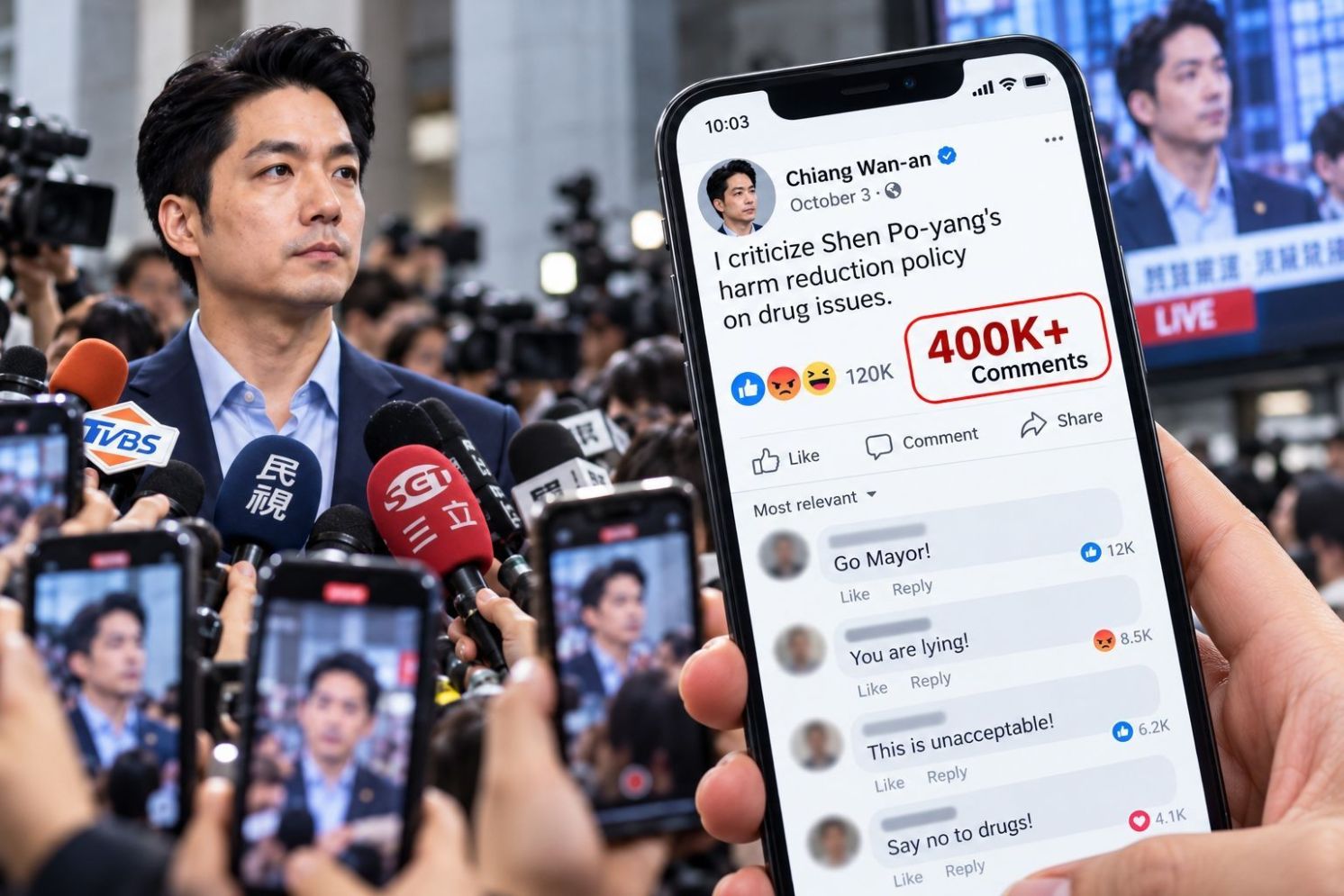
On the evening of October 3, Taipei Mayor Chiang Wan-an published a Facebook post criticizing Democratic Progressive Party (DPP) mayoral candidate Shen Po-yang's previous remarks on drug harm reduction policies. What appeared to be an ordinary exchange of attacks in an election campaign triggered a tidal wave of comments in an extraordinarily short period. The number surpassed the historical threshold of 377,000 comments recorded by Guinness World Records for the most comments on a single Facebook post within 24 hours.
Looking back over nearly 12 years of Taiwan's democratic development, political waves driven by social media have swept across the island several times: from the "Ko P" phenomenon associated with the White Force in 2014, the "Han Wave" in 2018, and the "Spicy Taiwanese Girl" phenomenon in 2019, to the "Yang Wave" in 2026. Politicians have gradually moved away from the image of traditional candidates, evolving into meticulously manufactured, packaged, and disseminated "political intellectual properties," or "political IPs."
The extraordinary successes of Ko Wen-je, Han Kuo-yu, Tsai Ing-wen, and Shen lie in their fully developed public personas, channels for emotional expression, and sense of collective identity. Algorithmic recommendation systems never evaluate "how important a particular proposal is to a city's long-term development." They care only about "whether a video can keep users engaged longer and provoke intense exchanges in the comments."
Can algorithms and online traffic be amplified through financial investment? The answer is yes. The decisive factor is who has the capital to purchase the initial spark that ignites viral content. The subsequent explosion of hundreds of thousands or even millions of views is effectively carried forward by algorithms at no additional cost.
Then comes the formidable barrier posed by the "content industry." The operations of modern campaign headquarters have increasingly come to resemble those of technology-driven media companies characterized by high-frequency content production and real-time feedback.
Reducing the dynamics of public opinion in modern politics to "cyber-army manipulation" seriously underestimates the sophistication of today's communications ecosystem. In Taiwan's political arena, the truly powerful force arises from the structural symbiosis of four mechanisms: political parties, government, media, and online networks. Political parties construct candidate personas and introduce emotionally charged triggers; public authorities continuously generate events through their official schedules; supporters and organized online communities take over the first round of content adaptation and dissemination; mainstream media, driven by the pursuit of clicks, rapidly transform social media popularity into breaking news; and the resulting television footage is then cut into 15-second vertical videos and circulated back onto Threads and other social media platforms.
Revisiting Mayor Chiang's Facebook post, which attracted more than 400,000 comments, reveals the absurdity of this closed loop of attention in its most extreme form. "Keep it up, Mayor!" and "You're lying!" represent diametrically opposed political positions. Yet to the algorithms operating behind the scenes, both are classified as "high-value user engagement." Large numbers of netizens, acting as unwitting collaborators in this spectacle, flooded the post to "pay homage," becoming the strongest catalyst for the next massive wave of comments.
However, this online offensive also involved a dynamic reversal of offensive and defensive roles. When negative comments numbered only several thousand to 10,000, the message received by undecided voters was that "the candidate's arguments have provoked public outrage." But when the volume of comments exceeded several hundred thousand, far beyond ordinary expectations, the focus of public opinion quietly shifted toward a different narrative: "the governing camp has mobilized its forces to launch a ruthless witch hunt against a single politician."
The most profound erosion of democracy caused by this competition for online traffic lies in the complete transformation of the nature of election campaigns. The core value of traditional democratic mechanisms is "rational persuasion," seeking the understanding and electoral authorization of centrist voters. Yet the underlying logic of algorithms inherently discourages persuasion across different social groups. The strategy offering the highest return on investment is to shift entirely toward "extreme mobilization," pushing voters with similar political positions to turn out and vote.
When a 30-second video of a candidate drinking bubble tea at a night market can easily overwhelm a 30-page urban renewal white paper that took months to develop; when an online offensive generating 400,000 comments filled with confrontational memes can dominate national news coverage for an entire week; public policy can only fade into the background amid the deafening clamor.